

This is part 4 of the mini-series within the regular popcorn devotions. If you haven’t already, read the first 3 (1 here, 2 here, 3 here)
I find it helpful, as I read through Exodus, to take a step back to better appreciate who Jesus is, what he has done, and what has been made available to us through him.
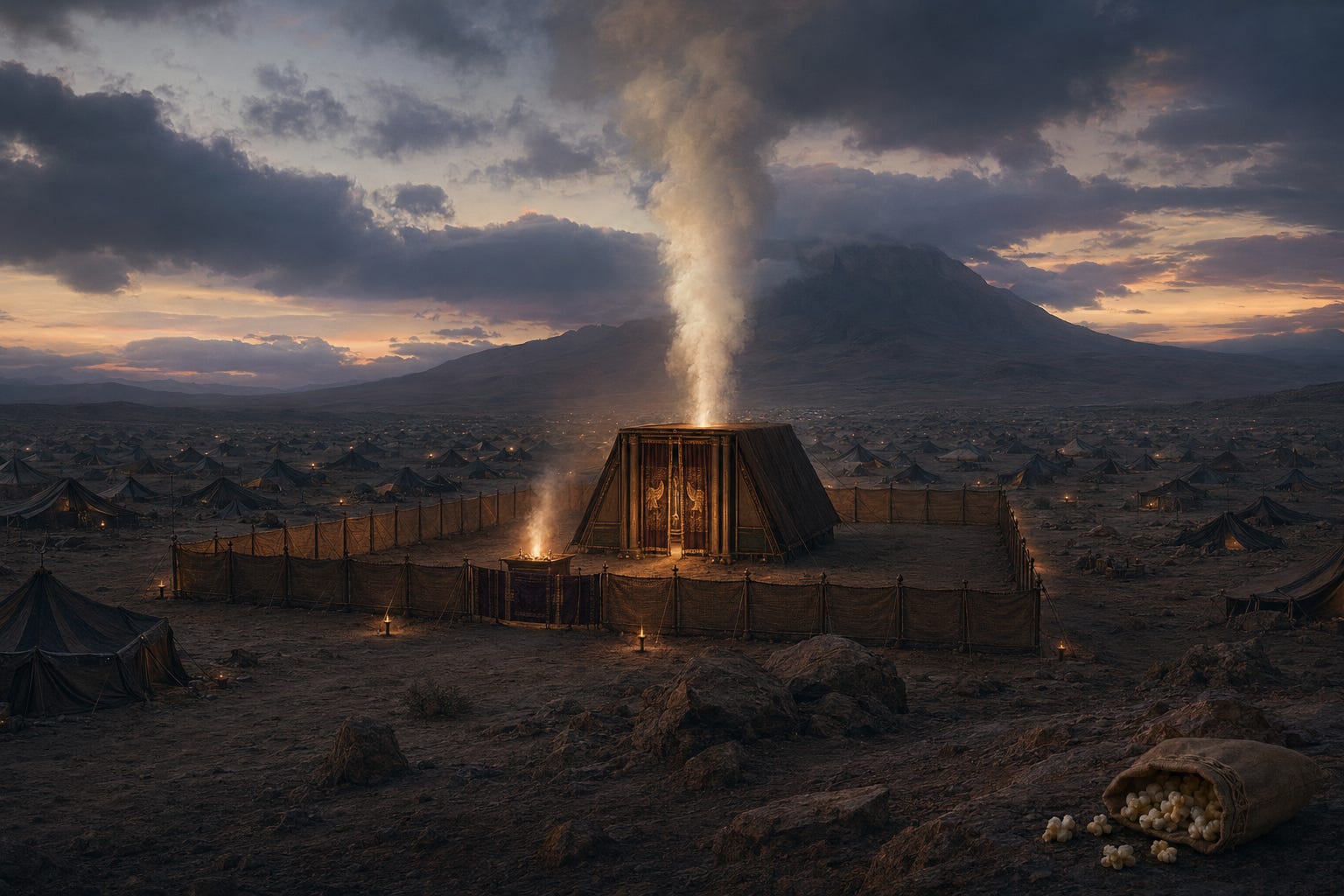
After God’s descent on Mount Sinai, we find nearly a dozen chapters in the second half of Exodus dedicated to the building of the ark of the covenant and the tabernacle, and to the way Israel was to approach God there.
Why is this significant?
Have the people of Israel build me a holy sanctuary so I can live among them.
Exodus 25:8
God transforms the temporary encounter at Sinai into a portable sanctuary so that his presence can travel with his people.
We move from a seemingly untouchable God on Mount Sinai to God setting up his tent in the middle of the camp, at the heart of their existence.
Of course, access remains limited. The problem introduced to us in Eden has not yet been fully resolved, but God continues to move closer.
Remember the cherubim?
The tabernacle carried echoes of humanity’s exile from Eden. Cherubim had guarded the way back into the garden after Adam and Eve were driven out. Now their images were woven into the curtain before the Most Holy Place, reminding Israel that the way into God’s sacred presence remained guarded.
But they also appeared above the ark, surrounding the place where God promised to meet with his people.
The boundary remained, but God had provided a way to approach him and had chosen to dwell among them.
What began for me as a gut reaction of, “This seems excessive,” when reading Exodus 19 has become an appreciation for the way God teaches and leads. He is who he is, and his holiness could literally crush us. This is what would have happened if he had not established limits for our protection and provided a way for us to approach him.
God’s desire has never been simply to visit his people from a distance, but to dwell among them.
As noted in the previous post, there is a difference between intimacy and informality. We are invited into relationship with God, but we are cautioned against treating him casually. The tabernacle holds these two truths together: God is holy and cannot be approached carelessly, yet he chooses to make his home among his people.
And this is where the story helps us better appreciate Jesus. The God who set up his tent in the middle of Israel’s camp would one day come even closer and make his dwelling among us.