

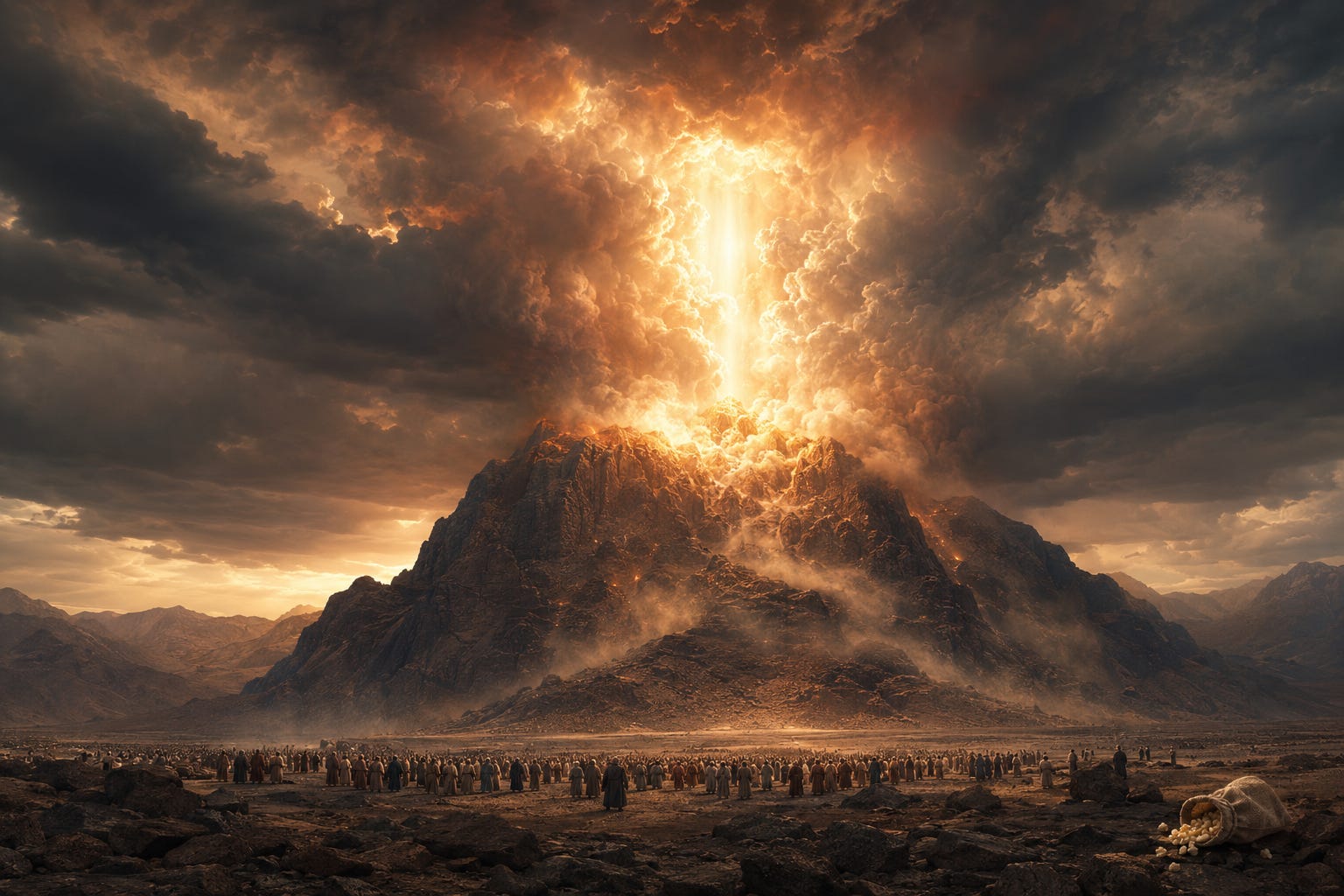
To appreciate what is happening here, I think it’s important to recognize that Exodus 19 is not so much about God keeping people away as it is about him coming toward them.
Although humanity could no longer safely enter God’s presence, God came down on Sinai to meet his people and draw them into covenant with him.
The Lord descended to the top of Mount Sinai and called Moses to the top of the mountain.
Exodus 19:20 (New Living Translation)
Throughout Scripture, mountains often become places of divine encounter. Their height evokes the meeting of heaven and earth, places where God reveals himself to humanity. But at Sinai, the most important movement is not Moses climbing the mountain. It is God coming down.
He descended. He came to them.
You’ll remember that in the early chapters of Genesis, we find God walking among humanity in the cool breeze. The scene is serene.
Here, hundreds of years after the events of Genesis 3, God descends and comes near again. Only this time, he comes with the full weight of his holiness.
Mount Sinai was covered with smoke because the Lord descended on it in fire. The smoke billowed up from it like smoke from a furnace, and the whole mountain trembled violently.
Exodus 19:18 (New Living Translation)
Because of sin, humanity could no longer safely experience that holiness. Thunder, fire, smoke, and trembling surround the God who has just called Israel his treasured possession. They were not yet ready to approach him. This is why, as we saw a few days ago, respecting the boundary was so important. It was not a threat; it was a safeguard.
The boundary does not mean that God wants to remain distant. All of this is happening precisely because he has come near.
At a time and in a cultural context where gods were common, this encounter reminds us that there is a difference between intimacy and informality. We are invited into relationship with God, but we are cautioned against treating him casually.