

(This popcorn devotion will be a little longer than usual)
In the book God Looks Like Jesus: A Renewed Approach to Understanding God, Greg Boyd opens the introduction with this quote:
It behooves us to be careful what we worship, for what we are worshiping we are becoming.
Attributed to Ralph Waldo Emerson
This is central to understanding why we must grasp the fullness of what Jesus accomplished through his life and ministry, and most importantly, through his death and resurrection.
As we’ve seen throughout the last few Popcorn Devotions, God came near and dwelled among his people throughout the Old Testament. Yet a distance remained. Access was guarded, surrounded by boundaries, sacrifices and ceremonial laws.
Remember what I wrote in Through the Layers:
So much of the Old Testament takes place within layers we don’t quite understand.
There was the culture of the day, with its customs, laws and assumptions. God entered that world and began reshaping it through his covenant with Israel. Over time, additional religious traditions and interpretations accumulated. Layer upon layer.
All this talk about Mount Sinai, the Ark of the Covenant, the tabernacle and the temple, along with the protocols and sacrifices surrounding them, is foreign to us. Quite frankly, some of it does seem excessive.
For the people at the time, however, much of it would have made sense. God met them in a world they understood to lead them further.
Step by step until his ultimate revelation.
The Word became flesh and made his dwelling among us. We have seen his glory, the glory of the one and only Son, who came from the Father, full of grace and truth.
John 1:14
When John says that Jesus “made his dwelling among us,” the word carries the idea that he tabernacled among us. This directly echoes the Old Testament picture of God dwelling among his people in the tabernacle and later in the temple.
For in Christ lives all the fullness of God in a human body.
Colossians 2:9 (New Living Translation)
Long ago God spoke many times and in many ways to our ancestors through the prophets. And now in these final days, he has spoken to us through his Son. God promised everything to the Son as an inheritance, and through the Son he created the universe. The Son radiates God’s own glory and expresses the very character of God, and he sustains everything by the mighty power of his command. When he had cleansed us from our sins, he sat down in the place of honour at the right hand of the majestic God in heaven. This shows that the Son is far greater than the angels, just as the name God gave him is greater than their names.
Hebrews 1:1–4 (New Living Translation)
Through his life, death and resurrection, Jesus dealt with the sin that kept humanity at a distance and opened a new way into God’s presence.
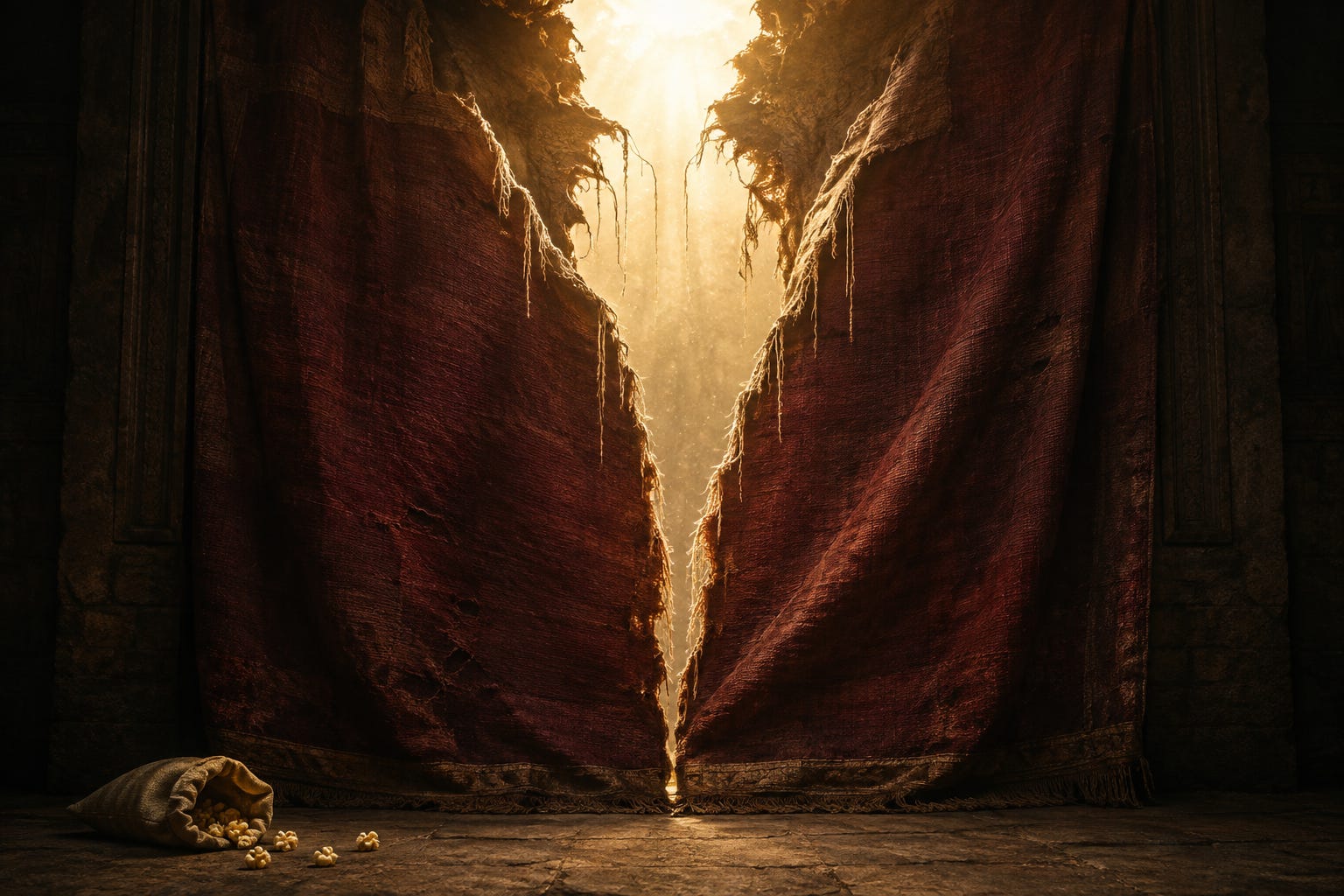
It was not by accident that the temple curtain tore at the moment Jesus died. Its tearing from top to bottom points to this being initiated by God himself. Humanity had not finally discovered a way to force its way into God’s presence. God was signalling that the way was now opened for us.
Then Jesus shouted out again, and he released his spirit. At that moment the curtain in the sanctuary of the Temple was torn in two, from top to bottom.
Matthew 27:50–51 (New Living Translation)
Jesus does more than grant access to a building. He identifies himself as the true temple and becomes both sacrifice and high priest. In his incarnation, he identifies with us in our humanity.
And so, dear brothers and sisters, we can boldly enter heaven’s Most Holy Place because of the blood of Jesus. By his death, Jesus opened a new and life-giving way through the curtain into the Most Holy Place. And since we have a great High Priest who rules over God’s house, let us go right into the presence of God with sincere hearts fully trusting him. For our guilty consciences have been sprinkled with Christ’s blood to make us clean, and our bodies have been washed with pure water.
Hebrews 10:19–22 (New Living Translation)
Entering the Most Holy Place at the wrong time, without the proper credentials, and without the required sacrifices meant death. Now, through Jesus, the way into God’s presence has become “a new and life-giving way.”
God has not become less holy, nor has sin become inconsequential. The barrier has been dealt with, at immense cost, by Jesus himself.
Jesus is what the Father has to say to us.
C.S. Lewis, Mere Christianity
We do not need to read the Bible as though we must somehow juggle the loving and merciful God revealed in Jesus with an Old Testament God who sometimes appears violent and vengeful.
Jesus is the final layer. He reveals God fully and completely. As Greg Boyd points out, we need not, and should not, consider every depiction of God equally accurate or authoritative.
I contend that the New Testament does not assume all biblical depictions of God carry equal authority. Instead, it considers Jesus to be the sole, perfect revelation of God’s character and purposes for the world.
Greg Boyd, God Looks Like Jesus: A Renewed Approach to Understanding God, page 21
Jesus does not merely tell us what God is like. He shows us.
The curtain tore because, through Jesus, God opened the way back into his presence.
The stage was now set for something even more intimate: for God to make his dwelling not merely among, but within his people.