

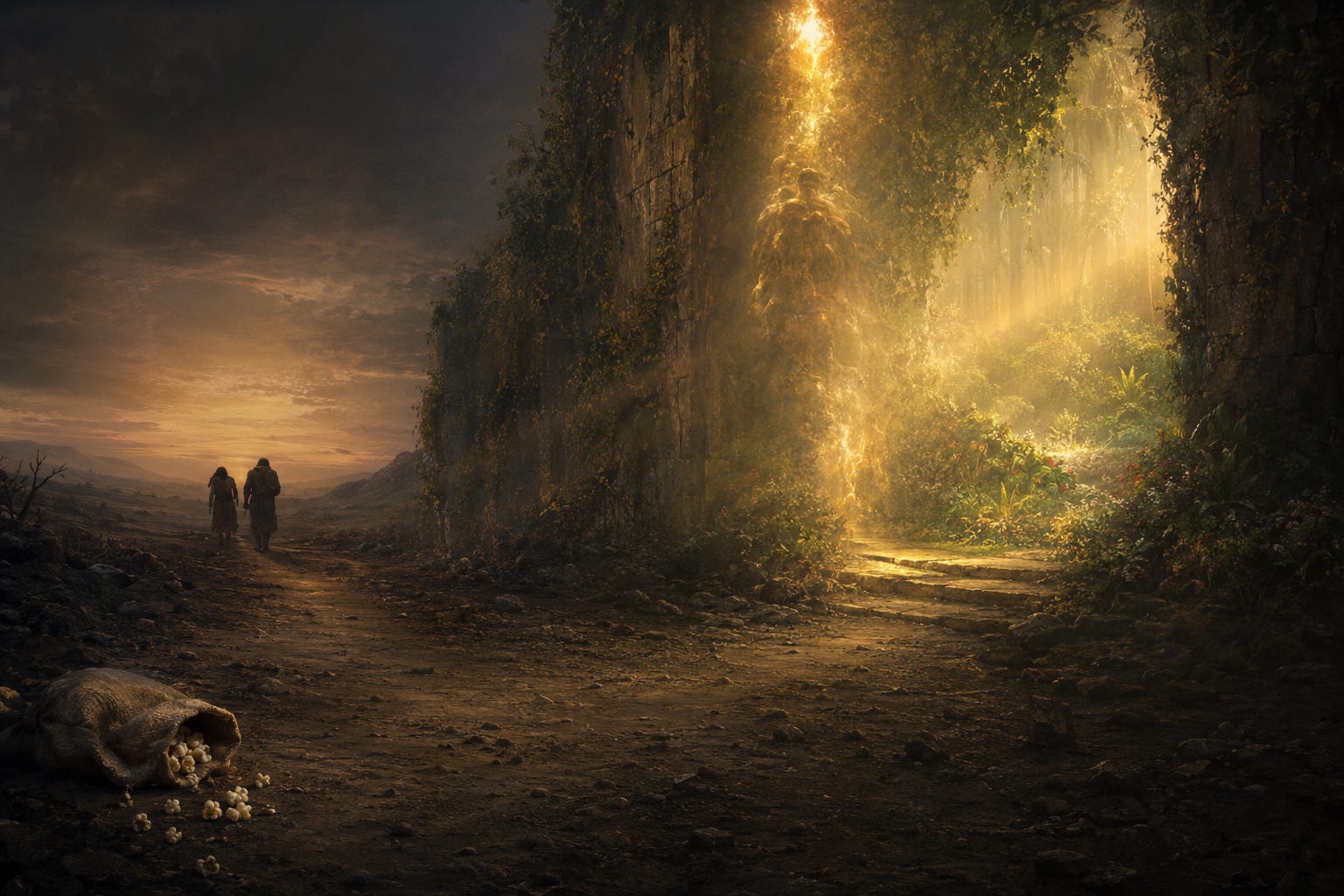
When the cool evening breezes were blowing, the man and his wife heard the Lord God walking about in the garden.
Genesis 3:8a (New Living Translation)
Yesterday, we found the Israelites at the foot of Mount Sinai, standing behind a boundary they were explicitly told not to cross. They could not enter God’s sacred space.
It was not always so.
In Genesis, we find humanity inhabiting sacred space. Adam and Eve are in the garden of God, the garden of Eden. God walks among them. There is unhindered communion and relationship.
Then something happens, and everything changes.
They go from being unashamed in God’s presence (Genesis 2:25) to being afraid and hiding from him (Genesis 3:8b).
Humanity was made to live with God, but sin turned intimacy into hiding and eventually resulted in exile from his sacred space.
Then the Lord God said, “Look, the human beings have become like us, knowing both good and evil. What if they reach out, take fruit from the tree of life, and eat it? Then they will live forever!” So the Lord God banished them from the Garden of Eden, and he sent Adam out to cultivate the ground from which he had been made. After sending them out, the Lord God stationed mighty cherubim to the east of the Garden of Eden. And he placed a flaming sword that flashed back and forth to guard the way to the tree of life.
Genesis 3:22–24 (New Living Translation)
The movement in Genesis 2 and 3 is from presence with God to mistrust and taking matters into their own hands; then to fear and hiding; and finally to exile from God’s sacred space. Humanity could no longer inhabit it. Sin had made unhindered access impossible, and the way back was guarded.
Keep the cherubim in mind. We will return to them in a few days.
The point of tracing the story back to the garden of Eden is to highlight the contrast between this sacred space and the one that came down on Mount Sinai.
The tragedy is not merely that humanity lost paradise. Humanity lost unhindered communion with God.
And yet, at Mount Sinai, God came down.
The boundary remained, but his descent showed that exile would not have the final word. If humanity could no longer freely enter God’s sacred space, God would make a way to dwell among us once again. In Exodus 19, he begins to show what it would take to bring us near again.
J’aime!
« Dieu est descendu… sa descente montrait que l'exil n'aurait pas le dernier mot… Dieu trouverait un moyen de demeurer à nouveau parmi nous ».