

(Among the popcorn devotions, this is part 5 of 8 in the mini-series inspired by Exodus 19)
For nearly five centuries, the Ark of the Covenant and the tabernacle remained portable or were housed in temporary structures.
The ark’s unsettled journey taught Israel that God’s presence was with them, but it was not theirs to control.
They had already tried using the ark as a weapon, assuming God would do whatever they wanted as long as the ark was with them. They carried it into battle like a religious good-luck charm, expecting God to support them regardless of their faithfulness (1 Samuel 4).
Under Solomon, God’s dwelling among Israel took on a stable architectural form. God established his dwelling at the heart of the nation in the temple, while reminding them that no building could contain him and no sacred structure could guarantee his favour.
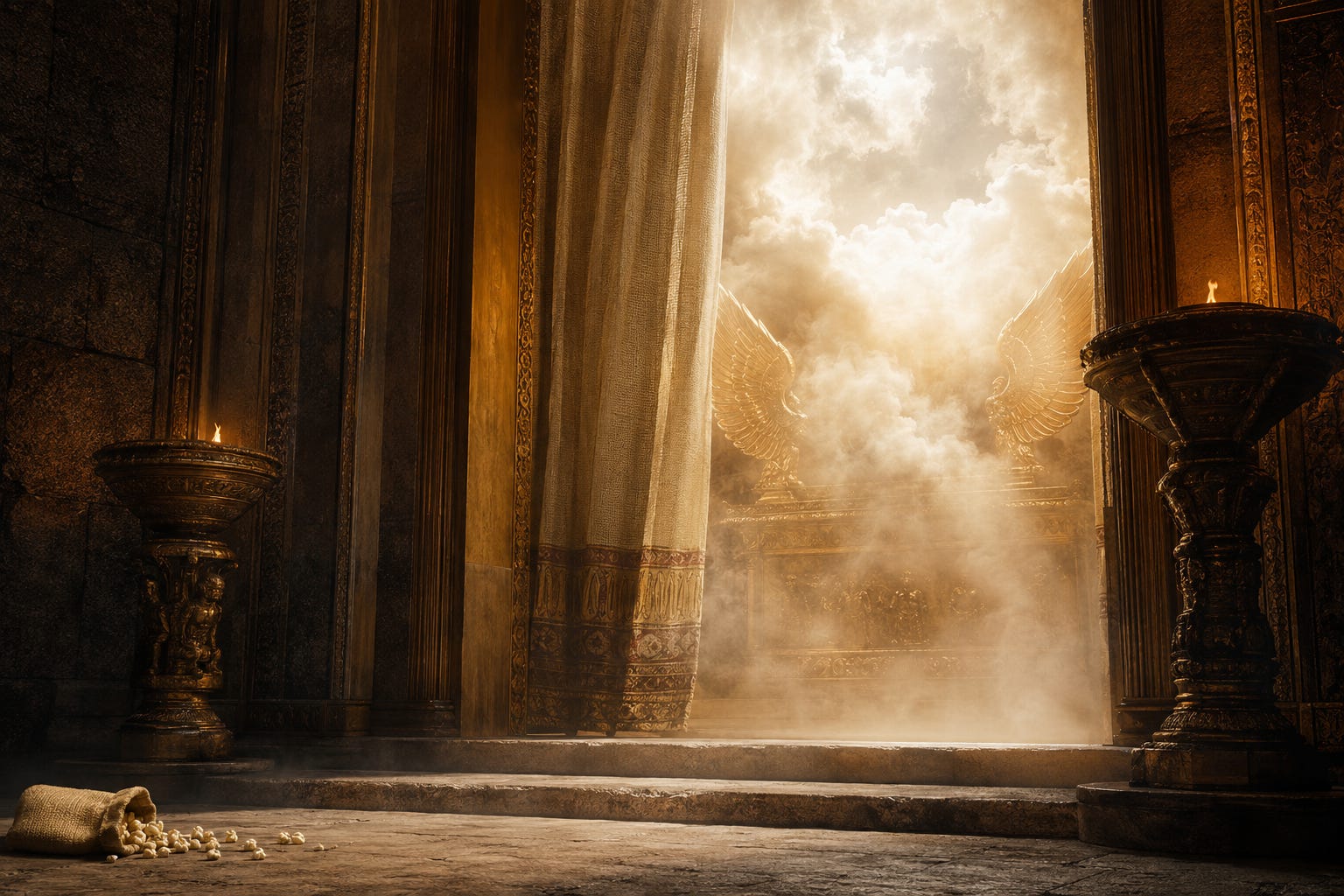
Then the priests carried the Ark of the Lord’s Covenant into the inner sanctuary of the Temple—the Most Holy Place—and placed it beneath the wings of the cherubim. The cherubim spread their wings over the Ark, forming a canopy over the Ark and its carrying poles.
Then Solomon prayed, “O Lord, you have said that you would live in a thick cloud of darkness. Now I have built a glorious Temple for you, a place where you can live forever!
But will God really live on earth? Why, even the highest heavens cannot contain you. How much less this Temple I have built! Nevertheless, listen to my prayer and my plea, O Lord my God. Hear the cry and the prayer that your servant is making to you today. May you watch over this Temple night and day, this place where you have said, ‘My name will be there.’ May you always hear the prayers I make toward this place. May you hear the humble and earnest requests from me and your people Israel when we pray toward this place. Yes, hear us from heaven where you live, and when you hear, forgive.”
1 Kings 8:6–7, 12–13, 27–30 (New Living Translation)
In verse 10, we read that when the ark enters the Most Holy Place, the glory of God fills the temple. God genuinely chooses to make his presence known there.
This was a significant moment of stability. The ark, the altar and Israel’s national worship were finally brought together in Jerusalem (the ark and the tabernacle had become separated some time before).
Yet, as Solomon acknowledged, the temple was God’s gracious gift, not a container that confined him.
The tabernacle emphasized that God travelled with his people. The temple emphasized that God had established his dwelling among them.
However, access to the Most Holy Place remained restricted and guarded. Again we see the cherubim. Only the high priest could enter, and only once a year, with sacrifice and great care.
God had moved closer, but the way into his immediate presence was not yet open to everyone.
God had moved closer, but the way into his immediate presence was not yet open to everyone. The story of God dwelling among humanity, however, would take an unexpected turn.