

Matthew’s genealogy ends in familiar territory.
Jacob was the ancestor of Joseph.
— Matthew 1:16
Matthew has a very interesting way of introducing Jesus. He crafts his genealogy very intentionally to make what seem to be two points:
What comes next picks up the promise storyline of the Old Testament. God promised Abraham that through him all nations would be blessed. This promise, and the hope that came with it, had pretty much died. Israel’s national identity and purpose were lost. Hope is now reawakened.
David, David, David. Matthew emphasizes the Davidic lineage not only by including David in the genealogy but by dividing the genealogy into three groups of 14. In Hebrew, the letters spelling David have the numerical value of 14.
Ok, as interesting as all that is, it’s not the point of this post. My focus as I read this morning was on Joseph. Not the Joseph, son of Jacob, we read about in Genesis. Not the Joseph who wound up in Egypt and was used by God to save his people. Not the Joseph whom God spoke to through dreams.
I’m talking about the other Joseph, the descendant of Jacob (not that one), who wound up in Egypt and was used by God to protect the one who would save his people. The one God spoke to through dreams.
You following? 😉
Joseph, the one who named Jesus, received him as his own and raised him with his wife, Mary. That Joseph.
We don’t know much about this Joseph, but here are a few highlights. There is no record of anything he ever said. He was a carpenter. He was a God-fearing man. He was a just man. A really good guy. He seems to have loved Mary.
What stood out to me is what we read in verse 19 of chapter 1:
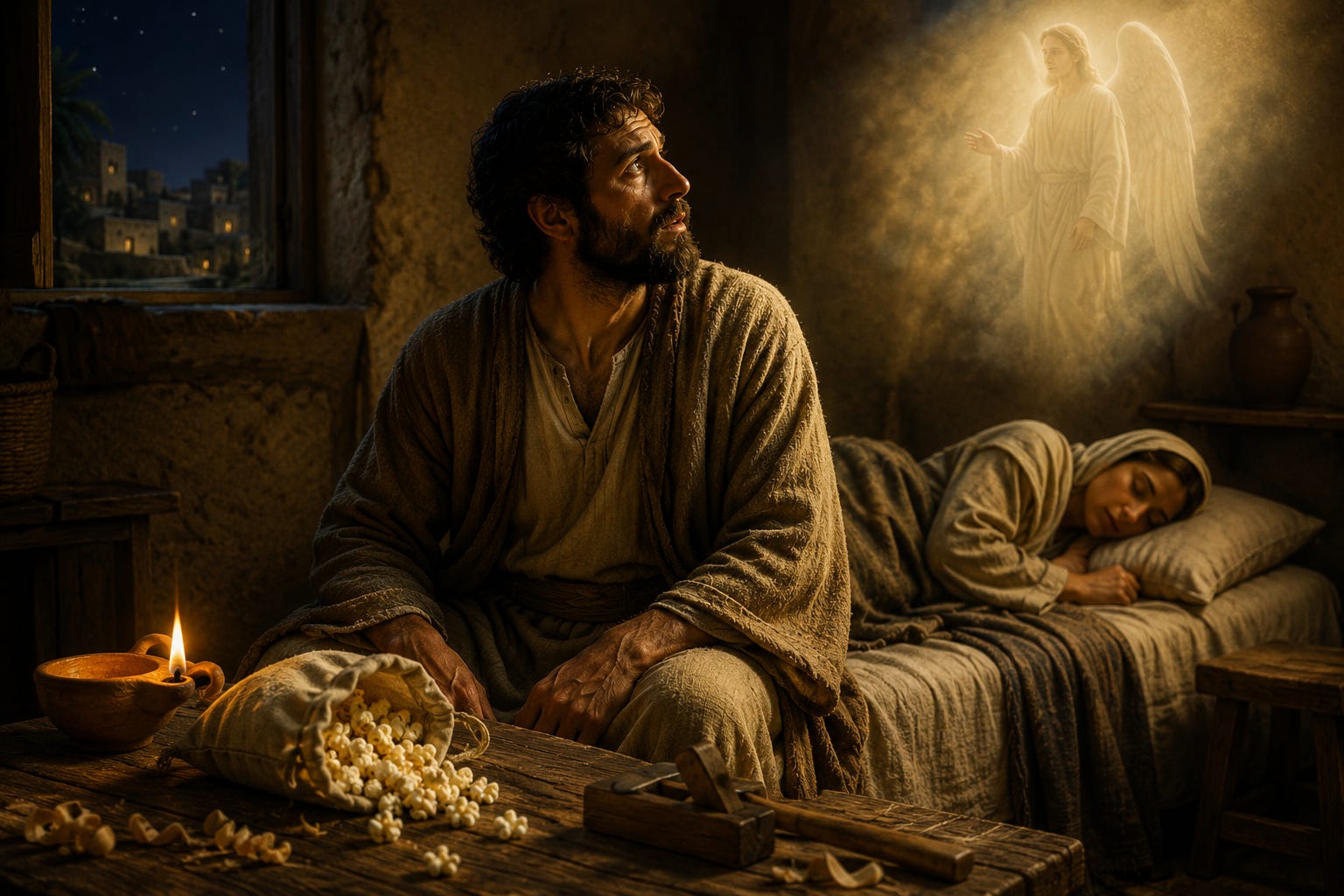
Joseph, to whom she was engaged, was a righteous man and did not want to disgrace her publicly, so he decided to break the engagement quietly.
He had just found out his soon-to-be wife was pregnant, and he was not the father. This was serious. He was well within his rights to split and, in doing so, leave her to be humiliated. I don’t know how that conversation went down when Mary tried to explain to him that she had not been with another man. I’ll leave that to your imagination.
What I’m interested in is how he reacted. Rather than exploding and looking for ways to make her suffer for it, because of his love for her and because he was a just man, he decided he would quietly separate and avoid making a fuss so as not to draw too much attention. He wasn’t going to stay with her, but neither was he going to humiliate her.
He was a righteous man. He was a God-fearing man. He listened to God. While he was considering the best way to leave Mary without drawing attention, God spoke to him in a dream and explained what was going on.
Joseph believed. He didn’t just believe; he said “yes.” Yes to naming the child. Naming the child symbolized taking him as his own. Yes to trusting God. Yes to remaining with Mary.
The following verses give us more examples of how he was someone who paid attention and listened to God’s prompting in his life. Through two other dreams, we read that he took Mary and the child down to Egypt to be spared from Herod’s psychopathic wrath. Later, again, he listened to God and took Mary and Jesus to Nazareth.
It’s no wonder this man is the one God had brought into Mary’s life. Jesus, the Righteous One, would be raised by a righteous man. A loving man.
Joseph pretty much disappears from the account after that. Other than seeing him again when Jesus is about 12 years old, we don’t read or hear anything else about him. He was not the point; Jesus was. Yet he had a pivotal and important role to play in the story.
Not unlike Joseph, maybe your life seems simple, insignificant and uneventful. Like Joseph, through faithfulness, love and obedience, you never know the great acts God might be working through you.
Such a beautiful post about Joseph. I myself have thought of him often and how the LORD saw a good man to raise His Son. Thank you so much for sharing this.